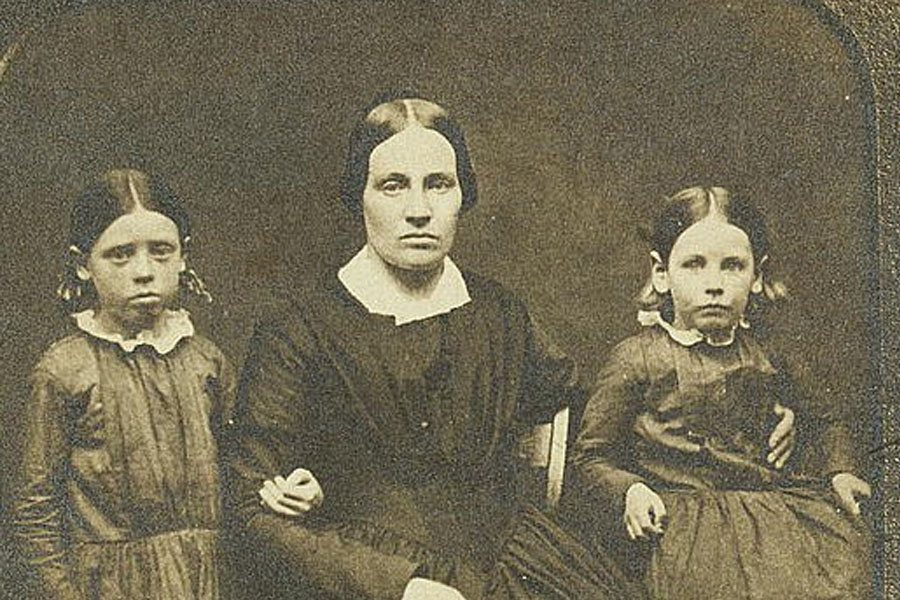
A Life Shaped by Work, Loss, and Resolve
I see Mary Ann Day Brown as the quiet center of a storm. She was born in 1816 and lived through a century that tested almost everyone she knew. Her life stretched across New York, Pennsylvania, Ohio, and California. She married John Brown when she was just 17, and from that moment her world became a mix of farm labor, childrearing, abolitionist danger, grief, and migration. She was not a public speaker in the grand style of her husband, but her life had its own fierce weight. It was the kind of life that held others together when the beams were cracking.
Mary came from the Day family. Her father was Charles Day, a blacksmith and farmer, and her mother is identified in family records as Mary Ann Little, sometimes listed as Mary Polly Little. Her upbringing in the North gave her the plain, durable habits of rural life. She learned endurance early. That trait later became her signature.
The Family She Came From
Mary Ann Day Brown did not emerge from emptiness. She came from a family network that placed her inside a wider web of sisters, brothers, and kin. Charles Day, her father, anchored the household through work and craft. In the stories that survive, he stands as the practical kind of man who could repair what was broken. Her mother, Mary Ann Little, appears in the background of the family record, less visible in the public memory but essential to Mary’s formation.
Her siblings and close relatives included Martha Day Delamater, Horace Day, John C. Day, Nancy Day Sybrandt, and Charles A. Day. These names matter because they remind me that Mary’s life was never isolated. She moved through family ties that stretched across the region, carrying obligations and loyalties that helped shape her adult choices. A person like Mary is often described through the famous husband she married, but she was already part of a living household structure before John Brown entered the picture.
Marriage to John Brown
Mary married John Brown in Crawford County, Pennsylvania, in 1833. She was 17. Widower with children. The plot alters quickly with that detail. She did more than marry. She joined a delicate, death-stricken home. She was the second wife, new mother, organizer, and supposed to soften loss’s edges.
John Brown had strong beliefs and actions. He had several children, was a farmer, tanner, businessman, and subsequently one of America’s most prominent abolitionists. Mary lived with that force. Not a peaceful marriage. They lived under a shadow of urgency. She stayed with him. For her, devotion was more important than decoration.
Like a lengthy bridge over rough water, their marriage. It brought births, deaths, moves, debts, and political risk. Mary kept walking on that bridge.
The Children and Stepchildren
The Brown household was large, blended, and constantly in motion. Mary became stepmother to five children from John Brown’s first marriage to Dianthe Lusk Brown. She also gave birth to a long line of children with John. Some lived long enough to build families of their own. Many died young. That contrast gives her life its sharpest ache.
Stepchildren from John Brown’s first marriage
John Brown Jr. was the eldest. He later became a teacher and a record keeper, and he was the only Brown son to serve in the Civil War. He helped preserve the family story in writing and memory.
Jason Brown was known for a gentler temperament and a humanitarian streak. He is often remembered as a pacifist in a family that otherwise moved toward conflict.
Owen Brown became the most dramatic of the sons after John Brown himself. He fought in Kansas, took part in the Harpers Ferry raid, escaped capture, and later lived in California.
Frederick Brown, the first Frederick, died in childhood. His life ended before it could be fully known.
Ruth Brown grew into adulthood, studied at the Grand River Institute, married Henry Thompson, and later lived in California. She became one of the bridges between the Brown family’s eastern and western chapters.
Children of Mary Ann Day Brown and John Brown
Sarah Brown, born in 1834, died in 1843 at just nine years old.
Watson Brown, born in 1835, married Isabella Thompson and joined his father at Harpers Ferry. He died from wounds after the raid.
Salmon Brown, born in 1836, married Abbie C. Hinckley, fought in Kansas, and lived until 1919.
Charles Brown, born in 1837, died in 1843.
Oliver Brown, born in 1839, married Martha Brewster, joined the raid, and died of wounds.
Peter Brown, born in 1840, died in 1843.
Austin Brown, born in 1842, died in infancy.
Annie Brown, born in 1843, helped at the Kennedy Farm before Harpers Ferry and later married Samuel Adams. She lived until 1926.
Amelia Brown, born in 1845, died in 1846 after a tragic accident.
Sarah Brown, born in 1846, never married and lived until 1916.
Ellen Brown, born in 1848, died in 1849.
An unnamed infant son died in 1852 after only 21 days.
Ellen Brown, born again in 1854, married James Fablinger and lived until 1916.
When I list these names, I feel the pattern of Mary’s life like stones in a riverbed. There were many children, but many graves too. She carried joy and grief in the same hands. That is not a small thing.
Work, Household Labor, and Survival
Mary Ann Day Brown did not build a modern career, but she worked constantly. Her work was domestic, agricultural, and political in effect if not in title. She managed a household that often had too many people and too few resources. She fed children, kept a roof standing, and moved with the family as John’s plans shifted from place to place.
Later accounts also describe her as a nurse and midwife in California. That detail matters because it shows how her care work extended beyond her own family. She was not only keeping her own people alive. She was helping others through bodily vulnerability, birth, illness, and recovery. In that sense, her labor was like an invisible net. Many lives passed through her hands.
She also appears in histories of abolition as a partner in action, not just sympathy. She supported John Brown’s anti-slavery commitments and was deeply tied to the moral world that shaped his mission. She did not live on the edge of the movement. She helped hold its domestic center together.
Financial Hardship and Later California Years
Money was always an issue. That is one of Mary’s most obvious truths. The Browns never rose in fortune. Under pressure, they moved. John’s radical beliefs and unstable profession made their finances worse. He wrote to Mary from jail, worrying about her travel funds. The family relied on friends, supporters, and sympathetic communities.
John Brown’s execution in 1859 made Mary’s life difficult. The shape changed. She moved west with her family to California in 1864. Her final chapter included Red Bluff and Saratoga. Though they battled in California, the Browns found a finishing ground. Mary lived to watch the family establish, scatter, and survive.
She died in San Francisco in 1884 and was buried in Saratoga. Her tomb added to the dust of recollection on a long path.
Extended Timeline of Mary Ann Day Brown
1816
Mary Ann Day Brown is born.
1833
She marries John Brown in Pennsylvania at age 17.
1834 to 1854
She gives birth to a large group of children, while also raising stepchildren from John’s first marriage.
1843
A year of heavy loss. Several children die young, and the Brown household is marked by sorrow.
1849
The family moves to North Elba, New York.
1850s
John Brown’s abolitionist activity intensifies. Mary remains the domestic anchor.
1859
Harpers Ferry. John and two sons go south. Mary waits, watches, and survives the aftermath.
1864
Mary moves to California.
1881
She lives in Saratoga, California, with Sarah Brown.
1884
Mary dies in San Francisco and is buried in Saratoga.
FAQ
Who was Mary Ann Day Brown?
Mary Ann Day Brown was John Brown’s second wife, the mother of many of his children, a stepmother to his children from his first marriage, and a key figure in the family’s abolitionist and frontier life. She lived from 1816 to 1884.
What kind of role did she play in the Brown family?
I would call her the family’s stabilizer. She managed a crowded household, raised children, cared for stepchildren, endured repeated death, and supported the family through years of instability and political danger.
How many children did she have?
She had eleven children with John Brown, and at least several stepchildren from his first marriage. Not all of her children survived childhood, which made her family history especially painful.
Did Mary Ann Day Brown have a career?
She did not have a formal modern career, but she worked constantly as a homemaker, farm partner, caregiver, and later as a nurse and midwife in California.
Why is Mary Ann Day Brown important?
She matters because history often remembers the loudest voice in the room. Mary was not the loudest voice. She was the structure beneath it. Without her, the story of John Brown and his family would feel unfinished, because she carried the domestic, emotional, and practical burden that made the family’s public life possible.